Last week, Netflix reported earnings.
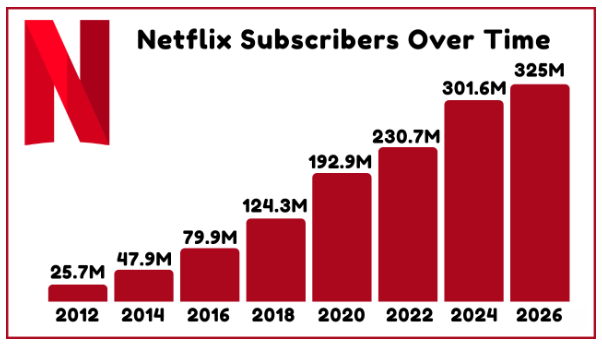
They beat expectations. Subscriptions were driven by a new season of Stranger Things and live NFL games.
Netflix also reportedly shifted its acquisition approach toward Warner Bros. Discovery to an all-cash deal valued around $72 billion.
And yet the stock still fell.
At first glance, that feels contradictory.
Until you zoom out.
🧠 Here’s the Question Most Investors Should Be Asking
Not:
“Why did Netflix fall?”
But:
“How does this show up in my portfolio?”
Because if you own a S&P 500 index fund Netflix is already in your portfolio.
📊 Netflix Inside the S&P 500 (What That Actually Means)
Netflix is one of the ~500 companies that make up the S&P 500.
But here’s the key:
-
Netflix is one holding
-
It represents only a small percentage of the index
-
Its daily ups and downs are diluted by the other 499 companies
So when Netflix drops on an earnings day:
-
Some companies in the index are up
-
Some are down
-
Many barely move
The index absorbs the impact.
Most long-term investors won’t feel this day at all.
🔁 Why “Good News, Down Stock” Doesn’t Break Index Investing
Netflix’s stock didn’t fall because the business failed.
It fell because markets trade on expectations, not headlines.
Netflix shares had already risen significantly. Strong results were priced in. Some investors took profits.
This is normal.
This happens constantly.
And it’s exactly the kind of short-term reaction index funds are designed to smooth out.
If you owned only Netflix, this day might feel emotional.
If you own the S&P 500, it’s barely a blip.
🧠 This Is the Real Advantage of Index Funds
Index investing isn’t about ignoring what’s happening.
It’s about not needing to predict how markets will react to what’s happening.
You don’t have to guess:
-
Whether earnings will “beat enough”
-
How Wall Street will interpret guidance
-
When profit-taking will happen
You already own Netflix.
You already own its competitors.
You already own the broader economy.
And time does the rest.
⏳ What Long-Term Investors Actually Experience
While headlines focus on single-day moves:
-
Index investors experience compounding
-
Diversification reduces emotional swings
-
Short-term noise gets quieter over time
Netflix will have more great quarters.
It will also have disappointing days.
The index doesn’t need to know which is coming next.
🧠 This Isn’t About Being Passive It’s About Being Strategic
Index investing isn’t saying:
“I don’t care what’s happening.”
It’s saying:
“I understand that short-term reactions are unpredictable and I don’t need to outsmart them.”
For most people (especially busy professionals), the real advantage of index funds isn’t just diversification it’s behavioral protection.
Fewer decisions.
Less emotional whiplash.
More consistency over time.
✨ The Takeaway
A strong company can still have a down day.
A good earnings report can still disappoint the market.
But when you own the S&P 500, you’re not betting on Netflix getting it right this quarter.
You’re betting on:
-
Innovation continuing
-
Businesses adapting
-
The economy growing over time
That’s why buy-and-hold index investing works not because it avoids volatility, but because it doesn’t require you to react to it.
And on days like this?
That quiet confidence is the whole point.